- The real gap: Distribution rarely fails only at the point of sale. It breaks between sales, insurer systems, finance teams and customer servicing.
- What end-to-end means: One platform connecting insurer APIs, onboarding, quotes, issuance, premiums, commissions, claims, renewals and reporting.
- Market context: Insurers sold 41.84 crore policies in FY 2024-25, and insurance penetration was 3.7% — FY 2024-25 figures, not 2026 projections.
- What to prioritise in 2026: Connected workflows, transparent controls and measurable operational improvement — not a long feature list.
Insurance distribution rarely breaks down at the point of sale alone. The bigger problem appears between sales, insurer systems, finance teams and customer servicing. End-to-end insurtech software connects these activities through one coordinated insurance distribution workflow.
For brokers, corporate agents, banks, non-banking financial companies (NBFCs) and fintechs, the objective is straightforward: distribute more effectively without multiplying manual work.
Insurers sold 41.84 crore policies in FY 2024-25, and insurance penetration was 3.7%, a government briefing said in April 2026. These are FY 2024-25 numbers, not projections for 2026. With the proliferation of distribution channels, technology needs to provide both customer access and operational accountability.
What Is End-to-End Insurance Software?
End-to-end insurtech software is a digital platform which connects insurer integrations, distributor onboarding, quotations, policy issuance, premium transactions, commissions, claims, renewals and reporting. It is not just a lead-generation tool. It is an insurance-specific customer relationship management tool.
Consider a broker operating a large Point of Sales Person (POSP) network. Without connected systems, agents compare products in insurer portals, operations teams update policy records, and finance teams reconcile commissions separately. In an integrated platform, each authorised role is configured with access and approvals, so the software provides a common operational view.
"End-to-end insurtech software connects sales, insurer systems, finance and servicing through one coordinated distribution workflow."
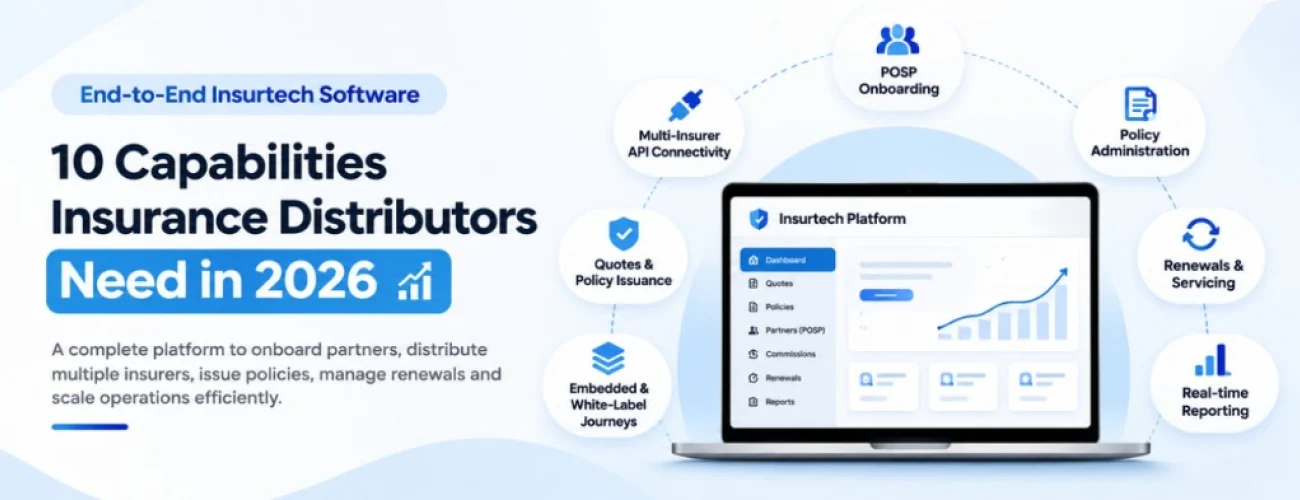
10 Capabilities Insurance Distributors Need in 2026
1. Multi-insurer API connectivity
A distributor needs access to insurers, products and pricing journeys. Separate integrations make expansion expensive because each insurer may use different fields, validation rules and responses.
Supported insurers are connected to the distributor’s software through an application programming interface (API) layer. That layer can pull quotes, submit proposals, share policy information and provide transaction status through workflows that are configured.
Do not stop at the number of integrations advertised. See which insurers and products are live, what each API can do, how failures are handled, and who keeps updates when insurer specifications change.
2. Digital POSP onboarding and management
Running a growing POSP network means identity verification, training records, product eligibility, user privileges and performance watching. When these tasks depend on email and spreadsheets, it is harder to follow up on activating new partners.
Insurance distribution software should capture onboarding documents, structure reviews, maintain training and authorisation records, and assign appropriate access.
FondosTech FT POSP Sure integrates onboarding with quotations, policy issuance, commissions and renewals. This reduces handoffs between the agent-facing experience and back-office administration, subject to the distributor’s authorised operating model. Explore FT POSP Sure.
3. Multi-insurer quotes and digital policy issuance
A fast quote is useful only when the customer can understand the options and complete the purchase. The software should bring supported insurer quotations into a comparable view, showing premiums, coverage terms, relevant exclusions and applicable conditions.
After selection, it should carry validated information into the proposal, support required consent and payment steps, and return the policy document or issuance status. Failed or pending transactions need visible exceptions rather than disappearing into a manual queue.
FT D2C Insure supports branded digital quotation and policy purchase journeys. Explore FT D2C Insure.
4. White-label and embedded distribution journeys
Distributors increasingly sell insurance where customers are already making another decision. A travel platform might offer trip protection when booking a trip, and a lender may offer eligible credit-related cover during the loan journey.
White-label insurtech software allows businesses to create branded experiences without having to build all insurance workflows from the ground up. Embedded insurance APIs can surface relevant products within a checkout, lending or service journey, with clear disclosures and affirmative customer choice.
FT Embedded Insure lets you offer insurance in context. FT Lending Insure links eligible protection to loan processes. Whatever technology is used, the essentials of product suitability, customer consent and distribution permissions remain.
5. Centralised policy administration and renewals
Issuing a policy is the beginning of the customer relationship, not the end. Distributors must handle policy records, documents, endorsements, cancellations, service requests and upcoming expiries.
A central policy workspace gives authorised teams access to the latest information. Automated renewal alerts can identify policies that require outreach, assign follow-up and record customer responses, so servicing opportunities are not missed.
- Does the system update status after changes on the insurer side?
- Does the system track a history of requests and note unresolved cases?
6. Digital claims and servicing workflows
Claims are where customers test whether their distributor can help after the sale. Disconnected emails, incomplete documents and unclear responsibilities create avoidable follow-ups, even when the insurer remains responsible for deciding and settling claims.
Digital claims software should support first notification, document collection, validation checks, case routing, status tracking and escalation.
FT Digital Claims offers document review, case tracking and AI-assisted handling in selected workflows. Human supervision and insurer decision-making still matter, especially in contentious, exceptional or sensitive cases. Explore FT Digital Claims.
7. Automation of commission, payout and reconciliation
The sale of a policy may involve financial activity between insurers, brokers, partners and POSPs. When policy records and insurer statements do not align, finance teams spend time chasing discrepancies before paying commissions.
Good insurtech software connects premium receipts, applicable commission structures, partner hierarchies and payout status. Reconciliation tools should compare insurer statements with internal policy and transaction records, flag exceptions, and maintain a reviewable history.
FT Reconciliation is FondosTech’s solution for statement matching and discrepancy identification. Pay-in and payout processes link financial activity to the overall distribution process.
8. Compliance controls and audit-ready records
Insurance distribution operates within authorisation, customer protection, disclosure and recordkeeping requirements. A good platform makes these responsibilities easier to administer through configured controls, rather than treating compliance as a report assembled later.
Look for consent records, role-based permissions, time-stamped activity logs, configurable approval rules, and retrievable transaction history. Data access, retention and security controls should be consistent with applicable legal and contractual obligations.
FT Compliance provides workflow controls, audit trails and reporting support. No software makes an organisation automatically compliant. Actual compliance depends on the relevant regulations, business arrangements, configuration and daily practices.
9. AI assistance with responsible decisions
Artificial intelligence can take some of the drudgery out of work, but the payoff depends on where you apply it. Helpful examples include finding missing information on proposals, suggesting relevant policy options, categorising service requests and flagging inconsistencies in claim documents.
For distributors, AI outputs should remain visible, testable and subject to business rules. Teams need to know when information is incomplete, when a case requires review, and which decisions must remain with authorised people or insurers.
FondosTech uses AI assistance in selected sales, underwriting support, claims and servicing workflows. Treat AI as a decision-support capability, not a promise that underwriting or claims approval becomes automatic.
10. Real-time reporting and scalable operations
A central dashboard should answer questions that matter to managers: Which channels generate policies? Where do proposals stall? Which renewals need attention? How many commission exceptions remain unresolved?
Useful analytics connect operational data across products, insurers, partners and teams. Distributors should be able to monitor quote-to-policy conversion, turnaround times, pending claims, renewal follow-ups and reconciliation workload without combining several spreadsheets.
Ask whether permissions, products, branch structures and insurer connections can expand without rebuilding workflows.
How to Choose the Right Insurtech Software
A more reliable buying process is to demonstrate one complete transaction, from onboarding or quote generation through issuance, servicing and financial reconciliation.
| Evaluation area | What to ask the vendor |
|---|---|
| Integration | Which insurer APIs and products are operational today? |
| Workflow | What happens when a proposal or payment fails? |
| Finance | Can teams trace a commission mismatch to its source? |
| Governance | Who can view, change, approve and export records? |
| Implementation | What must be configured, integrated and maintained? |
Where FondosTech Fits
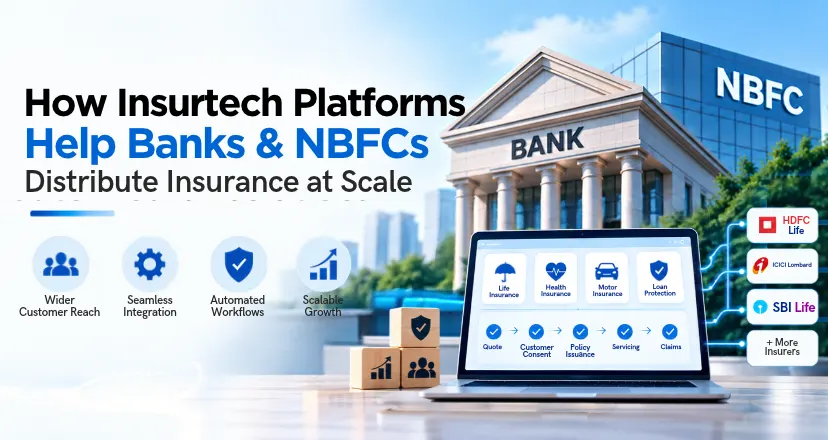
FondosTech provides a white-label, API-led insurtech platform for authorised insurance distributors, including brokers, banks, NBFCs and fintechs. Its product suite covers POSP management, direct sales, embedded and lending insurance, digital claims, payments, reconciliation and compliance support.
Conclusion
The right insurtech software does more than help distributors sell policies online. It connects the full insurance journey, from insurer access and partner onboarding to servicing, finance and oversight.
In 2026, prioritise connected workflows, transparent controls and measurable operational improvements over long feature lists. Speak with FondosTech to discuss the distribution processes you want to simplify and the integrations your business actually needs.
Frequently Asked Questions (FAQs)
Insurtech software uses digital tools to support insurance quotations, sales, policy administration, claims, commissions and other operations. End-to-end platforms connect these activities for insurers and authorised distributors.
Instead of separate systems, integrated workflows let brokers compare insurer products, manage POSPs, issue policies, track renewals, manage claims and reconcile commissions.
Prioritise insurer APIs, digital onboarding, quotation and issuance, policy servicing, claims, reconciliation, compliance controls, AI assistance and reporting. Match each feature to your distribution model.
No. A CRM is primarily a way of managing customer relationships and sales activity. End-to-end insurtech software also helps with insurer integrations, policy transactions, servicing, financial reconciliation and compliance-related records.