- Core Definition: Insurtech leverages modern technology to ease the process of selling, distributing, administering, and servicing insurance policies.
- The Indian Opportunity: In FY2024-25, insurance penetration in India stood at 3.7%, leaving immense headroom for tech-led expansion toward "Insurance for All by 2047".
- Connected Distribution: Automation and embedded insurance are transforming how banks, brokers, and fintechs distribute policies without manual spreadsheet friction.
- Lifecycle Management: Connected insurtech platforms allow distributors to unify carrier integrations, quote comparisons, policy issuance, claims processing, and automated renewals.
What Is Insurtech?
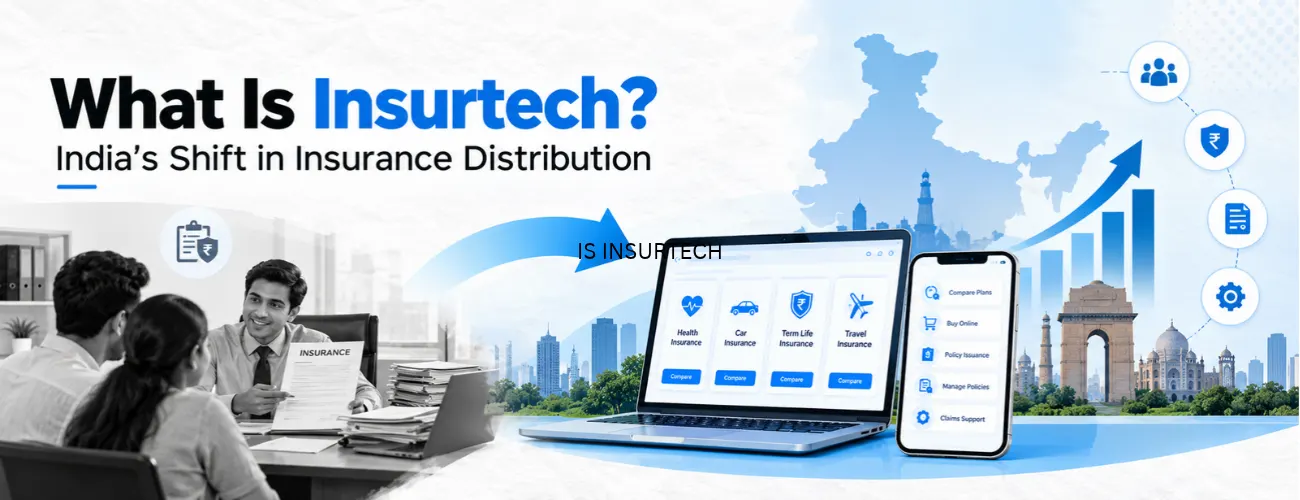
Gone are the days when buying insurance in India meant scheduling physical agent visits, submitting physical document stacks, and waiting weeks for paper policy stamps. Today, customers can compare policies, buy coverage in minutes, and submit claims seamlessly on digital channels.
This transformation is driven by insurtech—a synergistic blend of insurance operations and modern software engineering. Insurtech utilizes digital technologies such as Artificial Intelligence (AI), Application Programming Interfaces (APIs), Cloud Computing, and Workflow Automation to simplify insurance processes for customers, carriers, and intermediaries alike.
Consider a customer purchasing motor insurance:
- The Traditional Way: An agent manually gathers vehicle details, contacts multiple insurer branch managers, collects paper quotes, and fills out lengthy proposal forms by hand.
- The Insurtech Way: Through instant vehicle number lookup via Vahan APIs, customers or POSPs receive quotes from dozens of insurers, compare deductibles in real time, and complete purchase with instant digital policy delivery.
Crucially, insurtech is not just about selling policies through an online checkout. It connects every stage of the insurance lifecycle—from underwriting validation and policy binding to commission reconciliation, renewals, and claims processing.
"Insurtech is not simply about selling insurance online. It connects every fragmented phase of the insurance lifecycle—intake, underwriting, servicing, claims, and finance—into a unified operating backbone."
Why is Insurtech Crucial for India’s Insurance Market?
The insurance sector in India is colossal, yet access to adequate financial protection remains uneven across demographics and geographies. While India has built an impressive physical distribution network of nearly 83 lakh agents and intermediaries, overall insurance penetration remains low relative to global standards.
According to official data from the Ministry of Finance (April 2026) and the Reserve Bank of India (RBI), the scale and momentum of the Indian insurance sector are underscored by the following provisional statistics:
| Insurance Industry Metric | Latest Figure | Reporting Period |
|---|---|---|
| Total Insurance Premium Income | Rs. 13.3 lakh crore | FY2025-26, provisional |
| Life Insurance Premium Income | Rs. 10 lakh crore | FY2025-26, provisional |
| General Insurance Premium Income | Rs. 3.4 lakh crore | FY2025-26, provisional |
| Insurance Premium Growth | 11.7% | FY2025-26, provisional |
| Insurance Penetration (% of GDP) | 3.7% | FY2024-25 |
| Insurance Density (Per Capita Spend) | US$ 97 | FY2024-25 |
| Total Policies Issued | 41.84 crore | FY2024-25 |
| Total Claims Paid | Rs. 8.36 lakh crore | FY2024-25 |
| Insurance Distribution Network | Nearly 83 lakh | FY2024-25 |
These figures reveal an immense structural opportunity. India cannot achieve universal insurance coverage ("Bima for All by 2047") solely through legacy branch networks. Insurtech provides the essential connectivity layer—linking insurance carriers to everyday financial channels, eliminating administrative friction, and enabling scalable, high-trust digital distribution.
Traditional Insurance Distribution vs Insurtech-Led Distribution
Legacy distribution depends on fragmented teams, siloed carrier extranets, and endless spreadsheet tracking. Insurtech shifts these disconnected tasks into automated, interconnected workflows:
| Traditional Distribution | Insurtech-Driven Distribution |
|---|---|
| Manual customer onboarding & physical KYC | Instant digital onboarding & Aadhaar/PAN e-KYC |
| Logging into separate carrier portals individually | Unified multi-insurer API connections in one dashboard |
| Manual quotation collection via emails/calls | Automated quote requests & real-time comparison tables |
| Paper-based proposal documentation & physical courier | 100% digital proposal processing & instant policy binding |
| Spreadsheet-based policy & commission tracking | Centralised operational dashboards & automated ledger matching |
| Manual renewal follow-ups with high lapse rates | Automated WhatsApp/SMS renewal reminders & instant payment links |
| Disconnected claims updates & branch follow-ups | Real-time digital claims tracking & instant FNOL submission |
Importantly, insurtech does not replace insurance agents, brokers, or POSPs. Rather, it strips away time-consuming administrative burdens—allowing distribution teams to spend more time consulting customers, assessing nuanced coverage requirements, and building trusted client relationships.
6 Ways Technology Is Changing Insurance Distribution in India
The shift toward modern insurtech in India is underpinned by six key technological and operational pillars:
Modern insurance APIs enable different software systems to exchange data instantaneously. Without integration, bank relationship managers or broker teams are forced to switch between multiple carrier websites and re-enter the same applicant information repeatedly.
An API-led distribution engine brings participating insurers into a single unified interface—eliminating double data entry, reducing human error, and streamlining compliance logging across approved distribution channels.
Embedded insurance enables businesses to present relevant protection contextually during an existing commercial transaction, rather than redirecting buyers to third-party insurance websites:
- Travel & Hospitality: Flight and hotel cancellation cover offered at checkout.
- E-Commerce & Consumer Tech: Device protection and extended warranties during electronics purchases.
- Automotive & Mobility: Instant comprehensive motor insurance attached during vehicle sales.
- Lending & Credit: Credit life and personal accident protection bundled into loan disbursement flows.
FondosTech FT Embedded Insure: Enables banks, fintechs, and digital aggregators to embed compliant insurance options directly into existing customer touchpoints through lightweight APIs. Explore FT Embedded Insure.
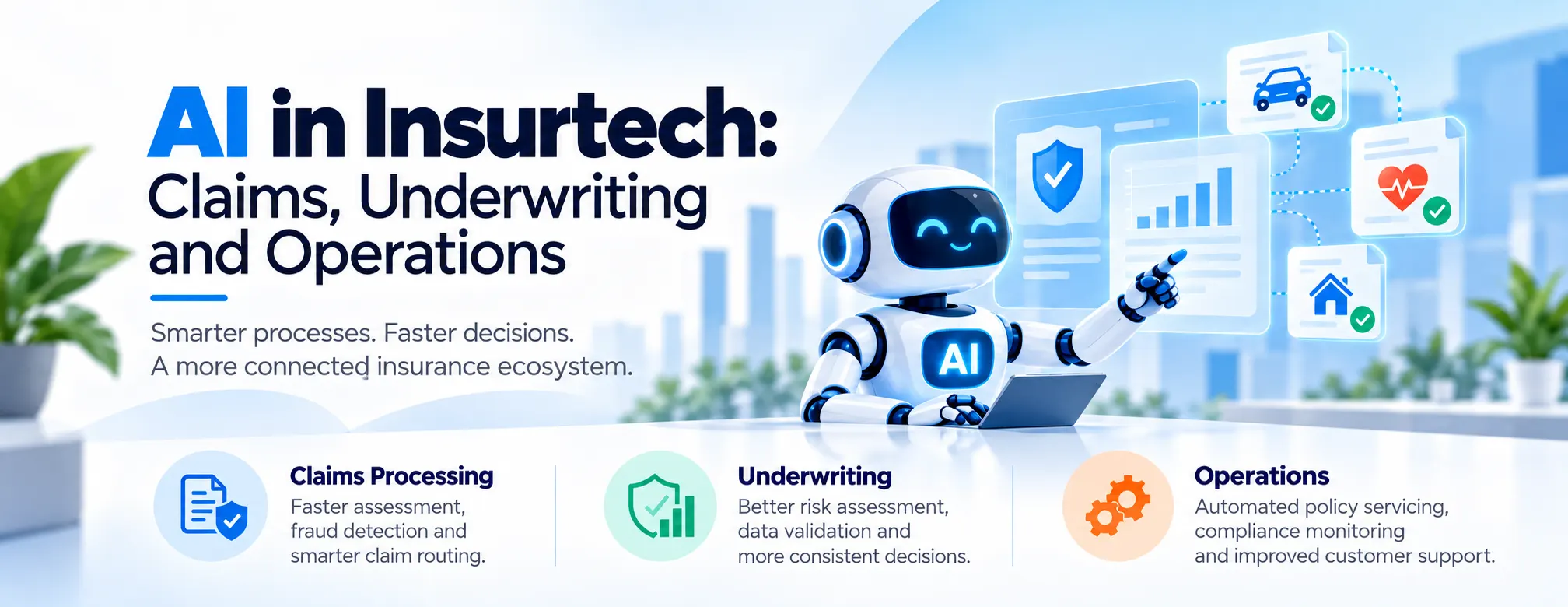
Artificial intelligence is assuming a central role in insurance servicing and underwriting support. AI tools evaluate high-volume structured and unstructured data, detect hidden risk patterns, and automate operational workflows:
- Data Extraction: Optical Character Recognition (OCR) and NLP instantly extract parameters from diagnostic files, RC books, and financial statements.
- Inquiry Summarization: Generative AI summarizes dense multi-page claims and suggests context-aware replies for customer support teams.
- Discrepancy Detection: Machine learning models flag contradictory claims information, duplicate hospital bills, and suspicious claims patterns.
- Operational Prioritization: Smart routing engines prioritize complex cases for senior adjusters while fast-tracking standard claims.
Note: AI does not supersede carrier underwriting guidelines, IRDAI regulations, or expert human decision-making; its role is to augment operational speed with robust oversight.
Point of Sales Persons (POSPs) play an instrumental role in taking insurance products into Tier-2, Tier-3, and rural India. However, managing hundreds or thousands of agents—covering onboarding, IRDAI certification training, quote issuance, and commission settlements—presents immense administrative friction.
Digital POSP platforms streamline this entire ecosystem. Brokers and corporate agents can onboard POSPs with paperless KYC, assign training modules, provide mobile quote engines, and balance payouts automatically.
FondosTech FT POSP Sure: Integrated POSP software supporting end-to-end agent onboarding, multi-insurer quoting, commission tracking, and mobile issuance. Learn more about FT POSP Sure.
Customer loyalty is won or lost during claims and renewal servicing. When servicing records are scattered across different spreadsheets, claims stagnate and renewal lapse rates climb.
Integrated digital claims systems consolidate policy data, automated renewal reminders, and document uploads into a transparent digital pipeline—giving customer support and branch teams real-time visibility into claims adjudication.
FondosTech FT Digital Claims: Unifies 50+ insurer claims APIs, offering automated document checks and live status tracking to cut processing cycles. Explore FT Digital Claims.
Banks, NBFCs, and fintechs increasingly prefer to distribute insurance under their own trusted customer-facing brand. A white-label insurtech platform provides configurable front-end interfaces, insurer connectivity, and back-office management.
Instead of spending years and millions of dollars building proprietary integrations from scratch, institutions can deploy turnkey, enterprise-grade technology to launch new insurance verticals in weeks.
How New Insurance Reforms Will Affect the Indian Market
The Indian insurance sector is witnessing landmark regulatory reforms led by the Government of India and the IRDAI, aimed at enhancing consumer affordability, capital inflow, and distribution efficiency:
| Insurance Reform | Key Changes & Developments | Impact on the Insurance Market |
|---|---|---|
| 100% FDI in Insurance (Amendment Act, 2025) | The Sabka Bima Sabki Raksha (Amendment of Insurance Laws) Act, 2025 raised foreign direct investment limits in Indian insurance companies from 74% to 100%. | Attracts global capital, encourages technological modernization, and fuels product innovation. |
| Simplified Intermediary Registration | Transitioned from recurring license renewals to a streamlined one-time registration system for intermediaries. | Reduces bureaucratic compliance friction, enabling faster business expansion. |
| Reinsurance Reforms | Reduced the Net Owned Fund (NOF) requirement for foreign reinsurance branches from Rs. 5,000 crore to Rs. 1,000 crore. | Encourages global reinsurers to establish Indian hubs, increasing domestic underwriting capacity. |
| Policyholder Protection Reforms | Institutionalized provisions for a dedicated Policyholders' Education and Protection Fund and strengthened grievance oversight. | Enhances consumer awareness, trust, and accountability across insurance transactions. |
| GST Exemption on Retail Insurance | Effective 25.09.2025, individual life and health policies (including family floaters) were exempted from the earlier 18% GST rate (group policies remain taxable). | Makes personal life and healthcare protection significantly more affordable for middle-class households. |
| IRDAI Proposed Distribution Reforms (2026) | Proposed commission caps and revised Expenses of Management (EoM) limits to discourage mis-selling and enhance cost transparency. | Encourages distributors to automate operations and transition toward lean, tech-driven distribution models. |
| Bima Sugam Digital Marketplace | IRDAI-backed unified electronic marketplace for insurance discovery, purchase, and servicing, with transactional rollout targeted around late 2026. | Democratizes digital discovery and establishes standardized infrastructure for policy servicing. |
| Growing Role of Insurtech Platforms | Intermediaries require connected workflows for multi-carrier policy sales, commission reconciliation, and statutory audit records. | Accelerates adoption of SaaS solutions like FondosTech across banks, brokers, and NBFCs. |
What Should You Look for in an Insurtech Platform for Your Business?
Selecting an insurtech platform is not merely a checklist comparison of features. The overarching question is whether the platform can reliably support your institutional distribution architecture and scale with your volume growth:
Does the platform provide ready, pre-built integrations with the specific insurance carriers and product lines aligned with your distribution agreements?
Does it cover the complete lifecycle—quotes, issuance, endorsements, claims, and multi-party financial reconciliation—or only front-end quotes?
Can it integrate into existing mobile apps, Core Banking Systems (CBS), Loan Origination Systems (LOS), and partner checkouts via REST APIs?
Does the software adhere to CERT-In standards, ISO 27001 data protection, role-based access controls, and tamper-proof IRDAI audit trails?
How FondosTech Supports Digital Insurance Distribution in India
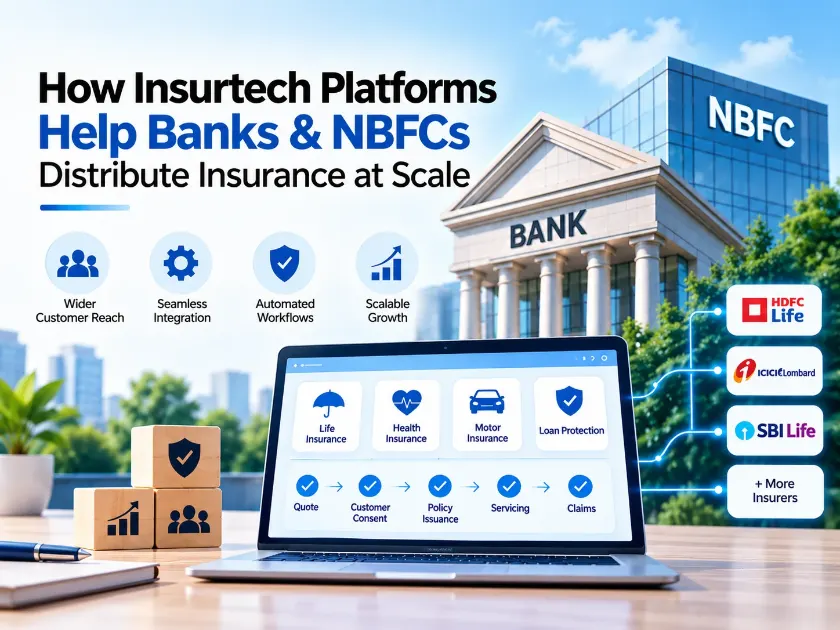
FondosTech is a specialized B2B insurtech SaaS platform engineered for banks, NBFCs, insurance brokers, corporate agents, and fintechs. Its white-label, API-led architecture bridges carrier connectivity, quoting engines, policy issuance, renewals, and financial reconciliation into one connected workflow.
Instead of juggling isolated systems for POSP onboarding, spreadsheet accounting, and claims follow-ups, businesses can run their entire distribution operations on FondosTech's modular software stack.
Challenges & The Future of Insurtech in India
What are the Key Challenges?
- Carrier API Disparities: Diverse insurer data structures and legacy core systems require ongoing engineering maintenance.
- Customer Awareness & Literacy: Ensuring consumers clearly comprehend policy deductibles, exclusions, and claim terms.
- Data Privacy & Governance: Strict compliance with India’s Digital Personal Data Protection (DPDP) Act and IRDAI information security mandates.
- Product Design Quality: Automation cannot compensate for poor underwriting design or aggressive sales practices; trust remains paramount.
What Lies Ahead?
- Insurance will increasingly become an invisible, embedded component of everyday digital financial transactions.
- Banks and lending platforms will lead insurance distribution through automated loan-linked workflows.
- Greater regulatory transparency and commission rationalization will reward operationally lean, technology-driven distributors.
Final Words
Insurtech is redefining India's insurance ecosystem by bringing together carriers, distributors, and consumers through connected technology. For banks, brokers, and fintechs, the imperative is clear: moving beyond isolated policy sales to building scalable, compliant, and customer-first insurance distribution infrastructure.
Frequently Asked Questions (FAQs)
Insurtech refers to the use of modern technology to enhance insurance services. It utilizes digital systems, APIs, cloud computing, and automation to streamline policy sales, customer onboarding, claims processing, and renewals.
Recent reforms include increasing FDI in insurance companies from 74% to 100%, reducing the minimum net-owned fund requirement for foreign reinsurers from Rs. 5,000 crore to Rs. 1,000 crore, exempting retail life and health insurance from 18% GST, introducing one-time intermediary registrations, and proposing revised commission and EoM limits.
IRDAI’s proposed distribution reforms aim to cap commissions and adjust Expenses of Management (EoM) to curb mis-selling and enhance cost transparency. For banks, brokers, and NBFCs, this necessitates adopting operationally efficient insurtech platforms to maintain profitability under revised commission frameworks.
Insurtech platforms connect insurance carriers to banks, brokers, NBFCs, and e-commerce platforms. Distribution becomes more accessible, contextual, and operationally efficient through unified APIs, embedded insurance at checkout, and AI-assisted claims.
Traditional insurance relies heavily on paper-based documentation, physical branch visits, and manual follow-ups. Insurtech uses digital connectivity, instant underwriting verification, automation, and data analytics to deliver frictionless, real-time insurance services.
Embedded insurance is the integration of relevant insurance products directly into everyday digital purchase journeys—such as buying travel insurance while booking a flight, gadget protection while purchasing an appliance, or credit protection while securing a loan.
An insurtech platform enables insurance brokers to manage multi-carrier integrations, compare quotes instantly, onboard and train POSP networks, automate commission reconciliation, and provide clients with seamless digital claims tracking from a single dashboard.