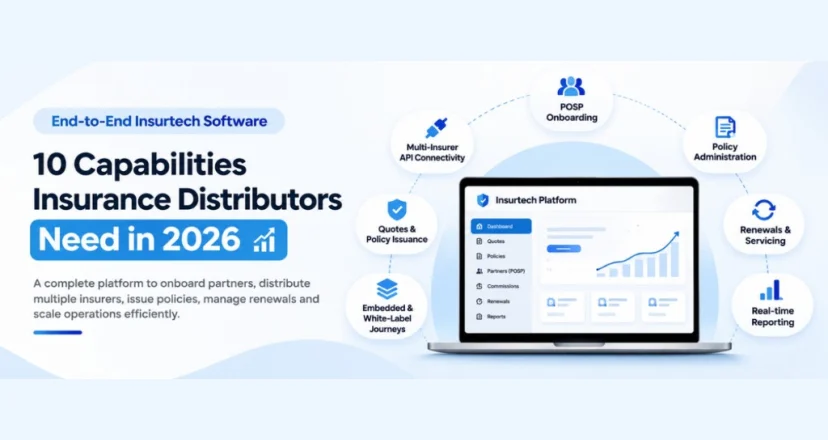
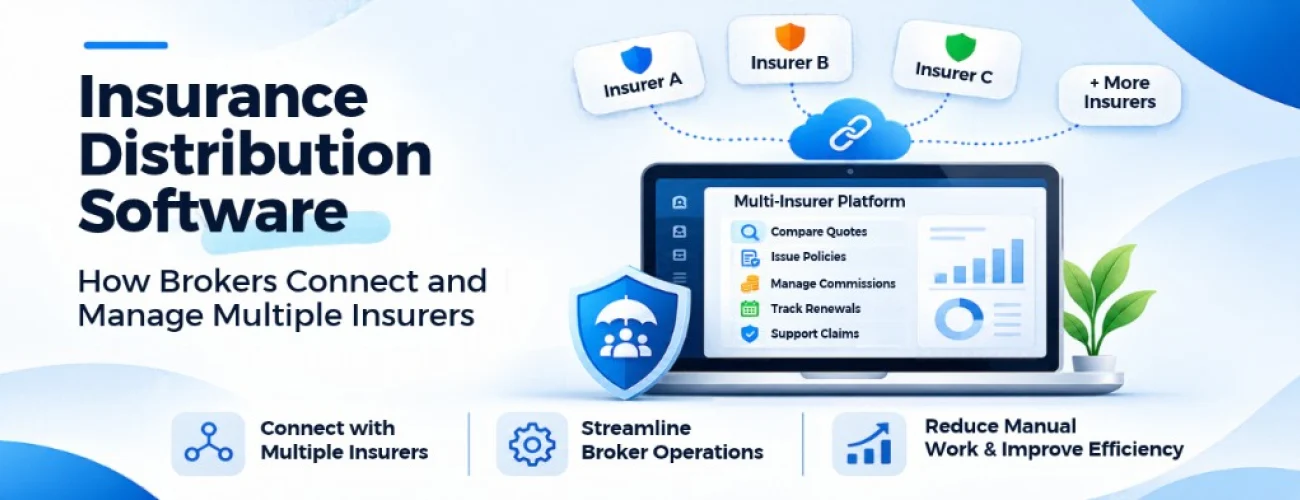
- One comparison view: Brokers can access products from multiple insurers and compare quotes through a single platform.
- Daily operations together: The software brings policy sales, commissions, renewals, claims and reporting into one place.
- Less manual work: It reduces duplicate entry while helping brokers follow insurer guidelines, meet customer needs and manage regulatory requirements.
An insurance broker can have several different insurers, each with different products, pricing rules and servicing processes. Managing these relationships through separate portals and spreadsheets leads to duplicate work.
Insurance distribution software connects supported carriers and brings quoting, policy issuance, commissions, renewals and servicing into a single operating workflow.
What Is Software for Insurance Distribution?
Insurance distribution software is a digital platform that permits authorised intermediaries to administer the sales and post-sales operations of insurance products. It can connect insurers, sales teams, customers and internal systems through application programming interfaces (APIs).
It is built to manage insurance processes, unlike a simple customer relationship management tool. Those processes include rules relating to eligibility, product selection, premium records, policy status and brokerage calculations. The platform enables the broker’s business. It does not replace professional advice or insurer underwriting.
"Managing multiple insurers should not mean managing multiple disconnected operations."
Why Brokers Need a Multi-Insurer Platform
India has a large broker-led distribution network. The IRDAI Annual Report 2024–25 recorded 771 valid insurance brokers as of 31 March 2025. These included 690 direct brokers, 77 composite brokers and four reinsurance brokers. The same report recorded 14,81,248 POSPs associated with insurance brokers at that date.
Without connected systems, one proposal may pass through several portals, email exchanges and spreadsheets. A small discrepancy in a customer’s details can delay issuance. Missing insurer statements can complicate brokerage reconciliation. Renewal opportunities may be overlooked because policy information sits in separate files.
A multi-insurer distribution platform gives the brokerage a common operating view. Available insurers and products still depend on commercial arrangements, registration permissions and enabled integrations.
How Insurance Distribution Software Connects Multiple Insurers
The connection typically works through APIs that allow the broker’s platform and an insurer’s systems to exchange authorised information.
1. Connect insurer products through APIs
Each insurer may use different fields, product structures and integration specifications. The software maps these differences into a common broker-facing journey. A customer enters information once, and the platform prepares requests in the formats required by supported insurers.
Not every insurer supports every API function. Some products require manual review. Check connectivity for all products and transactions you actually sell.
2. Compare relevant quotes
The platform checks the customer’s details and requests quotes from appropriate insurers. Brokers can review premiums, coverage limits, exclusions, deductibles and policy conditions before recommending a suitable option.
When comparing motor insurance, do not look only at the premium. Look at add-ons and claim terms. Price should not be the only consideration.
3. Submit proposals and issue policies
After the customer chooses an option, the workflow can send proposal details and supporting documentation to the selected insurer. Where supported, the platform receives the application status, payment confirmation and issued policy details.
Underwriting, acceptance and issuance remain subject to insurer rules. Connected workflows cannot guarantee instant approval.
4. Align policy records
Then comes distribution after the sale. A central policy register holds customer details, insurer details, product type, premium, policy number and expiry date. Teams use these records for servicing, reporting and renewal planning.
Which Broker Operations Can One Platform Manage?
| Broker activity | With disconnected systems | With connected software |
|---|---|---|
| Quotations | Multiple insurer logins and repeated entry | Supported quotes in a common workflow |
| Policy issuance | Status checked across separate portals | Central tracking of connected applications |
| POSP management | Separate onboarding and performance sheets | Digital onboarding and network visibility |
| Commissions | Manual matching of insurer statements | Structured matching and exception tracking |
| Renewals | Individual follow-up lists | Consolidated expiry alerts and task queues |
| Claims support | Emails and status calls | Document routing and available status tracking |
How Does the Technology Work in Practice?
Take a brokerage that supports motor and health insurance customers. With a connected platform, authorised staff enter customer information into a shared workflow and request supported quotes. When the customer chooses cover, the chosen insurer receives the proposal. When the integration allows, policy information is fed back into the brokerage’s central records.
Later, the finance team matches insurer statements against those policy records. The servicing team can view upcoming renewals and follow claim cases from the same system.
This is an illustrative workflow, not a claim that every product or insurer supports every step. The actual journey must be tested during implementation.
What Should Brokers Check Before They Choose Software?
A platform’s number of insurers helps, but it is not sufficient. Brokers should try the technology against actual business conditions.
- Insurer coverage: Check supported insurers, product lines and functions. A quotation-only integration is not a full proposal, payment and servicing integration.
- Workflow depth: Look for policy issuance, endorsements, cancellations, renewals, claims support, commissions and reporting that match your brokerage.
- Integration flexibility: Check APIs, compatibility with an existing CRM, payment connections, data migration and support when insurer specifications change.
- Security and governance: Examine access controls, audit trails, encryption and data retention. Technology should support regulatory requirements. Software alone does not make a brokerage compliant.
- Operational visibility: Ask for demos of failed API calls, pending proposals, unmatched commissions and escalation workflows. Exception handling matters as much as the successful path.
- Support and costs: Know who owns implementation, per-policy charges, maintenance, downtime procedures and the process for adding a new insurer.
How FondosTech Supports Connected Broker Operations
FondosTech offers insurance distribution technology that connects supported insurer workflows, policy operations and back-office processes. The platform describes access to more than 50 insurer integrations, subject to product availability and implementation requirements.
FT POSP Sure supports onboarding, eligible insurer access, quotations, policy issuance, commission workflows and renewal activity. Explore FT POSP Sure.
The broader suite includes reconciliation and payment workflows. FT Digital Claims supports claims intake, document checks, routing and status visibility across configured insurer or TPA workflows. Explore FT Digital Claims.
Conclusion
Insurance distribution software gives brokers a way to connect insurer relationships with quotations, policy records, commissions, renewals and customer servicing. Fewer duplicate tasks and clearer accountability strengthen the business case.
Brokers evaluating a platform should prioritise active insurer integrations, reliable exception handling and control over customer data. Speak with FondosTech to map the insurer workflows your brokerage needs to connect.
Frequently Asked Questions (FAQs)
It is software that allows authorised insurance distributors to manage insurer connectivity, quoting, policy issuance, commissions and servicing through connected digital workflows.
Yes. A multi-insurer platform can connect to supported insurer APIs. The products and transaction functions available depend on commercial agreements and the technical integration.
It matches policy records to insurer statements, highlights discrepancies, and supports controlled brokerage calculations and partner payments.