
A few years ago, a claims head at a mid-sized insurer told me something that stuck. “Fraud,” he said, rubbing his temples after a long day, “isn’t dramatic. It’s boring, repetitive, and expensive.” At the time, the industry was already bleeding money, but today the numbers are impossible to ignore. Insurance fraud costs Indian insurers an estimated ₹30,000 crore every year. That money doesn’t vanish into thin air—it quietly pushes premiums higher for honest customers and eats into already thin margins.
As claim volumes rise and processes become more digital, the problem has shifted shape. Manual checks, phone calls, and gut instinct no longer keep up. This is why claims management software has moved from “nice to have” to “non-negotiable.” Not because technology is trendy, but because fraud has become faster, smarter, and far more scalable than humans alone can handle.
In this post, I want to explore how modern systems help insurers detect and prevent fraud without turning every genuine claimant into a suspect. I’ll share real patterns from the Indian market, practical insights from implementations I’ve seen up close, and why the right technology—used thoughtfully—can actually improve customer trust rather than erode it.
Understanding the Shape of Insurance Fraud in India
Fraud in India isn’t one single monster. It’s a crowd of smaller problems wearing different masks. Some fraud is casual. A motor policyholder exaggerates repair costs. A health claim includes a couple of unnecessary tests. Individually, these look harmless. Collectively, they drain crores.
Then there’s organized fraud. Staged accidents, repeat hospitalizations, and networks of agents, garages, or clinics working together. These cases are harder to spot because each claim looks “normal” in isolation.
Traditional claims teams rely heavily on experience. A seasoned adjuster can often smell something off. But when you’re processing thousands of claims a month, instinct alone doesn’t scale. This is where claims management software quietly changes the game by spotting patterns no human can see.
Why Manual Fraud Detection Breaks Down
Let’s be honest: manual fraud detection was never designed for today’s volumes. I’ve seen claims teams juggling spreadsheets, PDFs, WhatsApp photos, and half-complete hospital bills. Even the most diligent investigator can only look at one claim at a time.
Fraud, however, lives in patterns across hundreds or thousands of claims. The same garage. The same doctor. The same accident location at the same time of day. Without automation, those connections stay hidden.
Modern claims management software doesn’t replace people. It gives them a wider lens. Instead of chasing every suspicion, teams focus on the 10–20% of claims that genuinely deserve attention.
How Modern Claims Systems Actually Detect Fraud
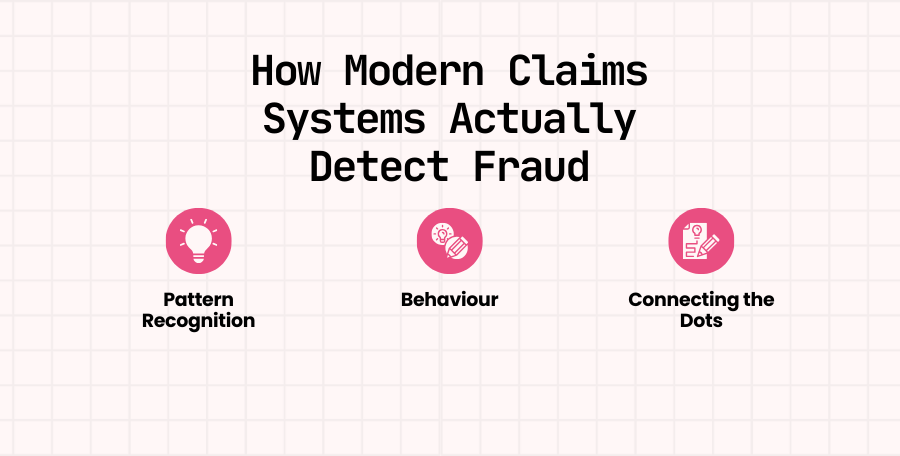
Pattern Recognition That Never Gets Tired
At the core of any good system is machine learning. It studies historical claims—both genuine and fraudulent—and learns what separates one from the other. Over time, it builds a risk profile for every new claim.
This is where claims management software shines. It doesn’t just ask, “Is this claim high?” It asks, “Is this claim high for this policy, in this location, at this time, with this provider?” Context matters.
Behaviour, Not Just Numbers
Fraud often shows up in behaviour before it shows up in amounts. A policyholder who files three claims in six months. A hospital whose average bill quietly creeps higher each quarter. A workshop that always seems to replace parts instead of repairing them.
Good systems track these trends continuously. When behaviour changes suddenly, alarms go off—even if each individual claim looks fine.
Connecting the Dots
One of the most powerful tools I’ve seen in modern insuretech platforms is network analysis. Imagine a web showing how claimants, doctors, garages, and agents are connected. Suddenly, a “random” claim is linked to ten others you flagged last year.
This capability alone has helped insurers uncover fraud rings worth crores. It’s also one of the clearest advantages of a mature claims management software system over basic rule-based checks.
Fraud Prevention Without Punishing Honest Customers
A common fear among insurers is that stronger fraud checks will slow everything down. Nobody wants a genuine claimant stuck in limbo because an algorithm got nervous.
The smarter approach is triage. Low-risk claims flow through quickly. Medium-risk claims might need an extra document. High-risk claims go to investigation.
When implemented well, claims management software actually speeds up legitimate payouts because teams stop wasting time on clean claims. I’ve seen insurers reduce average settlement times while also cutting fraud losses. That’s not a trade-off—it’s alignment.
The Role of Data (And Why Quality Matters)
Technology is only as good as the data it sees. In India, data quality can be messy. Names spelled three ways. Addresses that change formats. Missing IDs.
Before deploying claims management software, insurers need to clean house. That means standardizing data, integrating with external sources like vehicle databases or health records, and setting rules for consistency.
It’s not glamorous work, but it’s essential. Once the foundation is solid, the insights become sharper—and trust in the system grows internally.
Implementation: What Actually Works in Practice
Rolling out fraud detection isn’t a switch you flip. The insurers who succeed tend to follow a phased approach.
They start small. One line of business. One region. They let the system run alongside existing processes. Investigators compare machine recommendations with human judgment. Over time, confidence builds.
Training is critical. Claims teams need to understand why a claim was flagged, not just that it was. Transparency turns skepticism into adoption.
By the time claims management software is fully rolled out, it feels less like a new tool and more like a trusted colleague who never sleeps.